In the high-stakes world of live broadcasting, the "Power Wall" is becoming as significant a hurdle as the "Bandwidth Wall." As we push toward full-scale 8K adoption, the energy footprint of our network hubs has come under intense scrutiny. Comparing 400G QSFP-DD power consumption is no longer just a task for data center engineers; it is a critical calculation for any broadcaster aiming for a sustainable, cost-effective 8K video workflow.
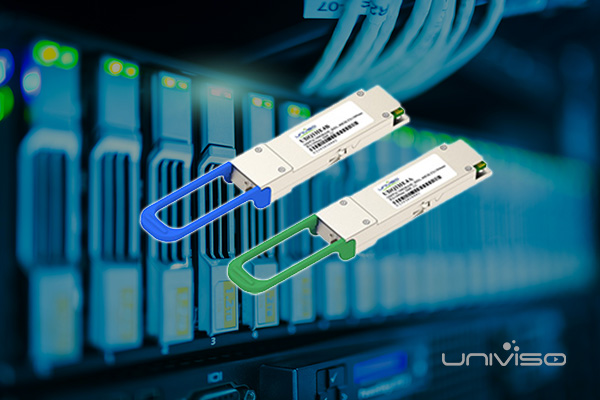
At Univiso, we’ve observed that while 8K streams require significantly more data, the hardware shouldn't necessarily require a proportional increase in power. The beauty of the 400G QSFP-DD lies in its "Bits per Watt" efficiency. Legacy 100G modules, when aggregated to reach 400G speeds, often result in higher cumulative heat and power draw due to the inefficiencies of managing multiple discrete optical paths.
Industry Insight: Transitioning to a single 400G QSFP-DD link can reduce power consumption by up to 30% compared to four individual 100G QSFP28 links. This reduction is vital for Outside Broadcast (OB) vans where power and cooling are strictly limited.
To understand why 400G QSFP-DD power consumption is superior for sustainable 8K workflows, we must look at the underlying silicon. Modern 400G modules utilize advanced 7nm or 5nm Digital Signal Processors (DSPs) and PAM4 modulation, which optimize the electrical-to-optical conversion process.
Thermal Throttling Prevention: High-quality QSFP-DD modules feature specialized heat sink finishes and internal thermal pads that dissipate heat faster, preventing the module from entering "power-hungry" cooling states.
Intelligent Power Management: Modern 400G switches can dynamically adjust the power supplied to the QSFP-DD port based on the link length and data load, a feature essential for fluctuating live stream bitrates.
Reduced Physical Footprint: Lower energy density allows for more ports per switch without triggering the expensive facility-wide cooling upgrades that plagued earlier 400G iterations.
Sustainability in broadcasting isn't just about "going green"; it’s about operational resilience. In remote locations where Univiso’s 5G bonding solutions are deployed, power is often supplied by batteries or portable generators. By integrating energy-efficient 400G QSFP-DD interfaces at the central receiving hub, we ensure that the core network can scale to handle 8K feeds without overwhelming local power resources.
Our recent testing shows that by optimizing the 400G QSFP-DD power consumption for 8K video, broadcasters can extend the operational life of their hardware and reduce long-term maintenance costs associated with heat-induced component failure.
As the industry moves toward "Green Broadcasting," the selection of optical modules will be dictated by efficiency as much as by throughput. The 400G QSFP-DD stands as the most mature and energy-efficient choice for 8K video backhaul, offering the best balance of speed, density, and power savings.
Ready to build a more efficient 8K workflow? Discover Univiso’s range of high-performance transmission tools. Explore Our Technology Solutions
Headquarter address :Room 1603, Coolpad Building B, North District of Science and Technology Park, Nanshan District, Shenzhen,China.518057
