In the controlled environment of a Tier-3 data center, achieving clean data transmission is standard. However, when you move that infrastructure into an Outside Broadcast (OB) van or a temporary field production kit, the rules change. As 8K video becomes the new benchmark for premium live events, engineers are finding that solving signal integrity challenges in 400G QSFP-DD is the difference between a flawless broadcast and a total signal collapse.
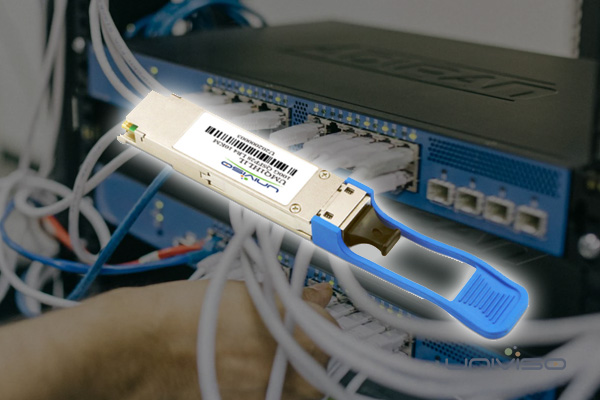
The leap from 100G to 400G wasn't just about adding more lanes; it was a fundamental shift in how signals are modulated. By moving to PAM4 (4-Level Pulse Amplitude Modulation), the 400G QSFP-DD module packs twice as much data into the same time interval as the older NRZ format. However, this reduces the signal-to-noise ratio (SNR) significantly.
In mobile production, where cables are frequently patched, moved, and subjected to electromagnetic interference from nearby power generators, the "eye" of the PAM4 signal becomes much smaller and harder for the receiver to distinguish. This leads to a spike in the Bit Error Rate (BER) before the signal even reaches the Forward Error Correction (FEC) engine.
At Univiso, we focus on three specific areas to ensure that our 8K transmission backbones remain rock-solid, even in the harshest field conditions:
QSFP-DD modules generate significant heat. In a cramped mobile unit, ambient temperatures can fluctuate rapidly. When a module overheats, its internal laser frequency can drift, causing jitter. Ensuring high-flow cooling and using modules with optimized thermal interface materials (TIM) is non-negotiable for 8K stability.
Dirt is the enemy of 400G. A single speck of dust on an MPO-16 connector can ruin the signal integrity of a 400G link. We advocate for rigorous "inspect-before-connect" protocols using digital fiber scopes, especially when deploying high-capacity links in outdoor environments.
Our expertise in multi-link aggregation allows us to build redundancy not just at the network layer, but at the physical layer. By understanding the intricacies of signal integrity in 400G QSFP-DD, Univiso helps broadcasters design production networks that are immune to the typical pitfalls of high-speed fiber optics in the field.
Headquarter address :Room 1603, Coolpad Building B, North District of Science and Technology Park, Nanshan District, Shenzhen,China.518057
