The transition to 8K resolution isn't just a visual upgrade; it's a massive infrastructure challenge. With four times the pixels of 4K, 8K video streams demand a network backhaul that can handle sustained, high-bitrate traffic without breaking the bank. For broadcasters and content delivery networks, finding a cost-effective 400G QSFP-DD migration strategy is now a top priority to remain competitive in the ultra-HD era.
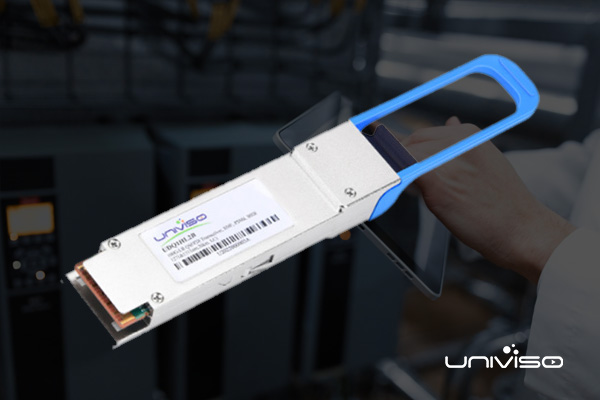
In the past, expanding bandwidth meant adding more fiber and more switches—a linear increase in cost. However, the 400G QSFP-DD (Double Density) form factor breaks this cycle by offering a density that allows for exponential growth within the same physical footprint.
At Univiso, we’ve analyzed how moving to 400G impacts long-term OPEX. By leveraging PAM4 modulation technology, these modules transmit twice as much data per symbol as traditional NRZ modules. This efficiency reduces the cost-per-bit significantly, making it the most viable path for the heavy data loads required by 8K live streaming.
Backward Compatibility: QSFP-DD ports can support existing QSFP28 and QSFP56 modules, protecting your current hardware investment.
Port Density: Achieve up to 14.4Tbps in a single 1U switch, drastically reducing rack space costs in data centers.
Reduced Complexity: One 400G link replaces four 100G links, simplifying cabling and decreasing potential points of failure in live production environments.
A successful 400G QSFP-DD migration doesn't have to happen overnight. A tiered approach allows for budget management while addressing immediate bottlenecks:
Identify where your 8K feeds converge. Typically, the bottleneck isn't the camera output but the aggregation switch where multiple 5G bonding streams meet. Upgrading this core layer to 400G provides immediate headroom for 8K peaks.
Heat is the enemy of optical module longevity. Choose QSFP-DD modules with optimized heat sink designs. This ensures that during long-form live events—such as sports or music festivals—your 8K live streaming backhaul remains stable and the modules don't throttle due to high temperatures.
As a specialist in multi-link aggregation, Univiso recommends integrating 400G links with intelligent bonding protocols. This ensures that even if one path fluctuates, the massive 400G pipe can re-route traffic dynamically, maintaining a "bit-perfect" 8K delivery.
The goal of a cost-effective migration is to ensure that the hardware you buy today is still relevant in five years. The 400G QSFP-DD ecosystem is the most mature and widely supported 400G standard, ensuring a broad supply chain and falling prices as adoption grows.
Univiso continues to lead the way in bridging the gap between field-capture and high-speed core networks. By adopting these 400G strategies, broadcasters can deliver the immersive 8K experiences audiences crave, while maintaining a lean and efficient operational budget.
Explore Univiso’s latest bonding and transmission solutions. Learn more about our technology.
Headquarter address :Room 1603, Coolpad Building B, North District of Science and Technology Park, Nanshan District, Shenzhen,China.518057
